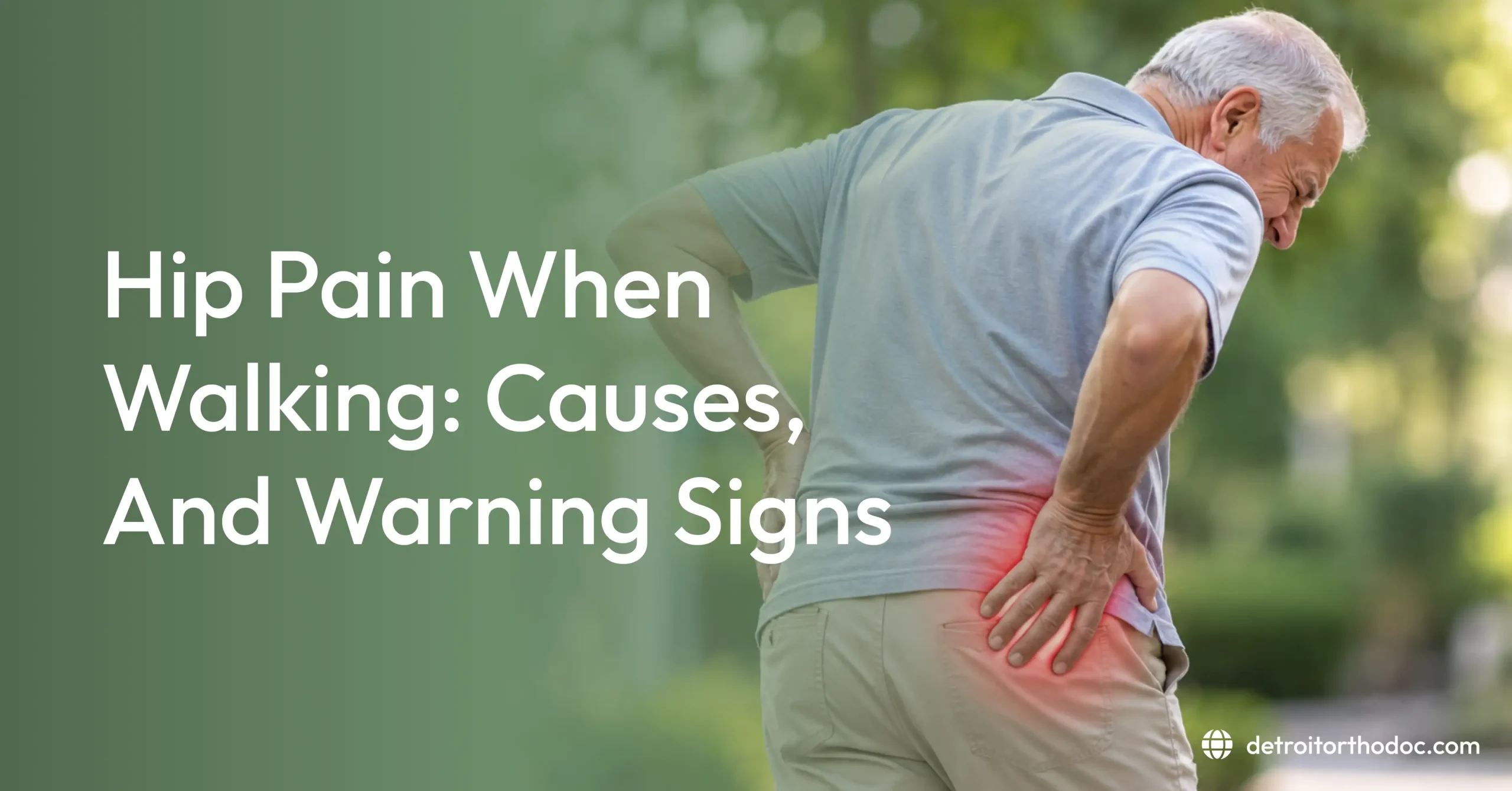
Quick answer: Hip pain when walking is most often caused by hip osteoarthritis, gluteal tendinopathy, a labral tear, or a muscle strain. Groin pain usually points to the joint itself, while pain on the outer hip usually points to the tendons. Most cases improve with physical therapy and load management. See an orthopedic doctor if pain lasts beyond two weeks, causes a limp, or wakes you at night.
Most people do not think about their hips until walking stops feeling automatic. A dull ache in the groin on the way to the car, a sharp catch stepping off a curb, or deep soreness halfway down a grocery aisle can all mean something is changing inside the joint.
Hip pain when walking is a common reason adults see an orthopedic specialist. It is also easy to ignore, because the discomfort often comes and goes for months before it becomes constant.
That delay matters. Data from the Johnston County Osteoarthritis Project put the lifetime risk of symptomatic hip osteoarthritis at 25.3 percent, or roughly one in four people (Murphy et al., 2010).
This guide explains what different pain patterns mean, how specialists find the cause, which treatments have evidence behind them, and which warning signs mean you should be seen. It is written for patients and caregivers and reflects how hip conditions are evaluated in daily orthopedic practice. For a broader overview of every hip condition, see our complete guide to hip pain.
Understanding Hip Pain When Walking
Hip pain when walking is a symptom, not a diagnosis. Each step loads the hip with impact, rotation, and single-leg balance, so cartilage, tendons, bone, and the joint capsule are all stressed at once. That is why many different conditions produce the same complaint.
How the Hip Joint Works
The hip is a ball-and-socket joint formed by the femoral head and the acetabulum of the pelvis. A rim of cartilage called the labrum deepens the socket and helps seal in joint fluid. The gluteal and deep rotator muscles keep the pelvis stable every time you shift weight onto one leg.
Measurements from instrumented hip implants show that ordinary walking loads the joint at roughly two and a half times body weight (Bergmann et al., 2001). A limp, a leg-length difference, or weak glutes push that load higher. This is why hip joint pain when walking often appears before pain at rest.
Where the Pain Sits Tells a Story
Location is one of the most useful clues, and it is often misreported. True hip joint problems usually cause groin or deep buttock pain. Pain over the bony bump on the side of the hip usually points to tendon or bursal tissue instead.
| Pain location | Most likely source | Typical description |
|---|---|---|
| Groin or front of hip | Hip joint: arthritis, labral tear, impingement | Deep, achy, catching, worse with pivoting |
| Outer hip over the bony point | Gluteal tendinopathy, trochanteric bursitis | Sharp or burning, painful to lie on |
| Buttock | Hip joint, sacroiliac joint, sciatic irritation | Deep ache, sometimes radiating |
| Lower back into hip | Lumbar spine referral | Worse with bending, numbness or tingling |
| Front or inner thigh down to the knee | Hip joint pain referred along the femoral or obturator nerve | Vague ache, no back symptoms |
What Causes Hip Pain When Walking
The cause depends heavily on age, activity level, and how the pain began. A 24-year-old soccer player and a 68-year-old retiree can describe the same symptom with completely different problems underneath.
Hip Osteoarthritis
Osteoarthritis develops as the cartilage lining the joint thins and loses its smooth glide. Typical signs are morning stiffness lasting under 30 minutes, groin pain that builds through the day, and trouble putting on socks or shoes. Walking distance usually shrinks gradually over months to years.
Gluteal Tendinopathy and Greater Trochanteric Pain Syndrome
Outside hip pain when walking most often comes from greater trochanteric pain syndrome (GTPS). GTPS is an umbrella term for gluteal tendinopathy, trochanteric bursitis, and iliotibial band irritation. It accounts for 10 to 20 percent of hip pain complaints seen in primary care and is more common in women (Seidman et al., StatPearls).
For decades this pain was simply called bursitis. A large ultrasound study of 877 patients with lateral hip pain found gluteal tendon changes in about half, while bursal fluid was far less common (Long et al., AJR 2013). The distinction matters, because tendon problems improve with progressive loading rather than rest and repeated steroid injections. Our guide to hip bursitis [spoke link: URL TBD] covers this in more detail.
Hip Labral Tears and Femoroacetabular Impingement
Labral tears cause deep groin pain, clicking, or catching, often with a sense that the hip is unstable. They frequently occur with femoroacetabular impingement (FAI), where extra bone on the femoral neck or socket rim collides when the hip bends. Younger, active adults are the classic group, and pivoting, deep squats, or standing after long sitting tend to flare symptoms.
Hip Flexor, Groin, and Adductor Strains
Strains cause sharp pain at the front or inner hip that starts with a specific movement, such as a sprint, kick, or slip. Unlike arthritis, they have a clear onset and improve steadily with graded rehabilitation. Repeated strains in the same spot can signal an underlying impingement or labral problem. See our article on hip flexor pain [spoke link: URL TBD].
Bone Stress Injuries and Femoral Neck Stress Fractures
Stress fractures appear in runners who increase mileage quickly, military recruits, and older adults with low bone density. The hallmark is groin pain that worsens with weight bearing, hurts at night, and does not settle with a few days of rest.
A stress fracture on the tension side of the femoral neck is urgent. Continuing to walk on it can lead to a complete fracture that needs surgical fixation. Any athlete with unexplained groin pain after a training increase should be imaged rather than reassured.
Referred Pain From the Spine and Sacroiliac Joint
Not every hip complaint starts in the hip. Lumbar disc disease, spinal stenosis, and sacroiliac joint problems all refer pain into the buttock and outer hip. Back pain, numbness or tingling below the knee, and normal hip motion on examination all point away from the joint.
Less Common but Serious Causes
- Avascular necrosis of the femoral head, linked to corticosteroid use, heavy alcohol intake, sickle cell disease, and prior trauma
- Septic arthritis or bone infection, usually with fever, severe pain, and inability to bear weight
- Inflammatory arthritis, such as rheumatoid arthritis or ankylosing spondylitis, often with long morning stiffness and other joints involved
- Bone lesions or metastatic disease, suggested by night pain, unexplained weight loss, or a cancer history
- Hip fracture after a fall. At least 300,000 adults aged 65 and older are hospitalized for hip fractures each year in the US, and more than 95 percent of hip fractures are caused by falls (CDC).
Hip Pain When Walking Up Stairs
Some people feel fine on flat ground and struggle badly on a staircase. Climbing demands three things level walking does not: deep hip bending combined with powerful extension, sustained single-leg support, and extra compression of the iliotibial band against the outer hip.
As a practical guide, groin pain on stairs points to the joint itself, such as arthritis, impingement, or a labral tear. Outer hip pain on stairs points to gluteal tendinopathy. Pain going down stairs more than up often involves the knee or quadriceps control rather than the hip.
Why Only One Hip Hurts
Right hip pain when walking, or pain only on the left, is the norm rather than the exception. Most hip conditions are mechanical, and load is rarely shared evenly. Leg-length differences, a dominant push-off leg, an old ankle or knee injury, and sleeping habits all bias load toward one side.
One-sided pain is not alarming by itself. What matters is the pattern, the progression, and whether it responds to load management over two to three weeks. Pain in both hips raises the possibility of inflammatory arthritis or a spinal cause and usually warrants earlier evaluation.
Symptoms: Early, Progressive, and Emergency
Pain in the hip when walking rarely stays the same. Knowing which stage you are in helps you judge how soon to be seen.
Early symptoms
- Stiffness in the first few minutes of walking that eases as you warm up
- A mild groin or outer hip ache after longer walks that resolves overnight
- Occasional painless clicking
- Less comfort crossing your legs or getting out of a low car seat
Progressive symptoms
- Pain that starts earlier in the walk and lasts longer afterward
- Night pain or trouble lying on the affected side
- A visible limp or a shorter stride on one side
- Trouble with socks, shoes, or nail care on the affected side
- Shrinking walking distance and avoiding stairs
Emergency warning signs (seek same-day care)
- Inability to bear weight after a fall or injury
- A leg that looks shortened or rotated outward
- Fever, chills, or a hot, swollen joint
- Sudden severe groin pain in someone with osteoporosis or a cancer history
- Numbness, weakness, or loss of bowel or bladder control
- Rapidly worsening pain that repeatedly wakes you at night
When to See a Doctor for Hip Pain When Walking
A reasonable rule is two weeks. If hip pain when walking has not clearly improved after two weeks of reduced activity and over-the-counter measures, it deserves a proper evaluation.
Book sooner if you notice a limp, night pain, shrinking walking distance, or symptoms that interfere with work or sleep. Athletes with groin pain after a training increase should be assessed promptly because of stress fracture risk. Adults over 65 who have fallen should be evaluated the same day.
Early evaluation is not about rushing toward surgery. It is about finding the cause while conservative treatment has the best chance of working.
Not sure whether your symptoms need evaluation? Call 248-329-0711 to speak with our team in Troy.
How Hip Pain Is Diagnosed
Accurate diagnosis separates effective treatment from months of trial and error. A structured orthopedic assessment usually moves through four stages.
History and gait analysis. Your surgeon will ask when the pain started, what changes it, where exactly you feel it, and how far you can walk before it appears. Watching you walk can reveal a Trendelenburg pattern, where the pelvis drops on one side, which suggests abductor weakness or gluteal tendon damage.
Physical examination. Tests are chosen to separate joint problems from soft tissue problems. Common ones include the FADIR test for impingement and labral pathology, the FABER test for joint and sacroiliac involvement, and pressure over the outer hip and resisted abduction for gluteal tendinopathy. Loss of internal rotation is one of the earliest signs of hip arthritis.
Imaging.
| Imaging test | What it shows best | When it is used |
|---|---|---|
| X-ray | Joint space narrowing, bone spurs, fractures, hip shape | Almost always the first study |
| MRI | Labrum, cartilage, tendons, bone marrow edema, stress fractures | When X-rays are normal but symptoms persist |
| Ultrasound | Gluteal tendons, bursae, injection guidance | Suspected outer hip tendinopathy |
| CT scan | Detailed bone anatomy, complex fractures | Surgical planning, hidden fractures |
Both in-office X-ray and diagnostic ultrasound are available at DetroitOrthoDoc, which shortens the gap between the first visit and a working diagnosis.
Diagnostic injection and lab tests. An injection of local anesthetic into the joint can confirm whether pain truly comes from the hip, which helps when spine and hip problems coexist. Blood tests are ordered when inflammatory arthritis or infection is a possibility.
Treatment Options for Hip Pain When Walking
Most patients with hip pain when walking improve without surgery when treatment matches the correct diagnosis. Conservative care is the starting point for nearly every cause except fracture, infection, and advanced structural damage.
Activity and load modification. The goal is to reduce irritating load without losing conditioning. That usually means swapping high-impact exercise for cycling, swimming, or an elliptical, and shortening walks rather than stopping them. For gluteal tendinopathy, it also means not crossing your legs and not sleeping on the painful side.
Physical therapy. Structured exercise therapy has strong evidence for hip osteoarthritis and for gluteal tendinopathy (Barratt et al., Br J Sports Med 2017). Programs combine hip abductor strengthening, core and pelvic control, gait retraining, and graded loading. Progress is usually measured over six to twelve weeks, so stopping after a few sessions rarely gives therapy a fair test.
Medications. Acetaminophen and topical anti-inflammatories are reasonable first choices. Oral NSAIDs can help but carry stomach, kidney, and heart considerations that rule them out for some patients. Long-term opioids are not recommended for chronic hip pain.
Injections. Corticosteroid injections can give meaningful short-term relief, especially for arthritis flares and bursal inflammation. Repeated steroid injections into tendon tissue are avoided because they may weaken it.
Gel injections, or viscosupplementation, are FDA-approved for knee osteoarthritis only. Use in the hip is off-label, the evidence is limited, and your surgeon will discuss whether it is reasonable in your case.
PRP treatment uses concentrated platelets from your own blood. Early evidence for gluteal tendinopathy is encouraging but still developing. PRP is not FDA-approved for these uses and is often not covered by insurance, so it is best treated as one option among several.
Assistive devices and weight management. A cane held in the hand opposite the painful hip reduces load on the joint and often lets you walk farther, not less. Modest weight loss lowers cumulative joint stress. Anyone at fracture risk should have vitamin D and bone density addressed.
| Factor | Non-surgical care | Surgical care |
|---|---|---|
| Best suited to | Early arthritis, tendinopathy, strains, most first visits | Failed conservative care, structural damage, fractures, advanced arthritis |
| Typical time to benefit | 6 to 12 weeks | 3 to 12 months, depending on procedure |
| Risk profile | Low | Higher, including infection and blood clots |
| Reversibility | Fully reversible | Permanent anatomical change |
Surgical Options When Conservative Care Is Not Enough
Surgery is considered when pain limits daily life despite a genuine trial of conservative treatment, or when the structural problem will not heal on its own.
Hip arthroscopy uses small incisions and a camera to repair labral tears, reshape impinging bone, and address cartilage damage. It is generally outpatient, with crutches for a few weeks and structured rehabilitation. Read our detailed overview of hip arthroscopy recovery and outcomes.
Gluteal tendon repair is an option for full-thickness tears that have not improved with loading programs. Partial tears often improve without surgery, so careful selection matters. If repair is appropriate, Dr. Matthew Yousif, DO can discuss your options or a referral.
Total hip replacement is reserved for advanced arthritis with bone-on-bone changes and significant loss of function. Many appropriately selected patients now go home the same day or after a short stay. Outcomes vary by individual, and no surgeon can promise a specific result.
Recovery Timeline
Recovery depends on the diagnosis and procedure. These ranges reflect typical patterns, not guarantees.
| Timeframe | Gluteal tendinopathy (non-surgical) | Hip arthroscopy | Total hip replacement |
|---|---|---|---|
| Week 1 | Load management, pain settling | Crutches, gentle motion | Walking with an aid |
| Weeks 2 to 6 | Isometric, then progressive loading | Weight-bearing progression | Independent walking, stairs |
| 3 months | Clear improvement for most | Strengthening, light sport | Most daily activities restored |
| 6 months | Full activity for most | Return to pivoting sport for many | Comfortable walking, ongoing gains |
| 12 months | Maintenance strengthening | Peak recovery for most | Final outcome typically reached |
Desk workers typically return within one to three weeks after arthroscopy and two to six weeks after hip replacement. Jobs involving lifting, ladders, or long hours standing usually need six to twelve weeks or more. Return to running or league play is cleared on strength and control benchmarks rather than calendar dates. Our page on sports injuries covers return-to-play care in more detail.
Prevention Checklist
- Strengthen hip abductors and glutes at least twice a week
- Build running or walking volume gradually; a common guideline is no more than about 10 percent per week
- Maintain a healthy body weight
- Favor hip mobility work over aggressive stretching of irritated tendons
- Replace worn walking or running shoes
- Address vitamin D, calcium, and bone density, especially after 50
- Break up long periods of sitting every 30 to 45 minutes
- Reduce fall risk at home with good lighting, grab bars, and clear walkways
- Take extra care on winter ice
Common Mistakes and Myths
Mistakes patients make
- Waiting too long. Many patients arrive after a year of symptoms, when fewer conservative options remain.
- Assuming outer hip pain is bursitis. Most cases are tendon problems, which do not respond well to rest and repeated steroid injections.
- Aggressively stretching an irritated tendon. Iliotibial band and figure-four stretches compress the gluteal tendons and often worsen outer hip pain.
- Stopping physical therapy early. Tendons and arthritic joints respond over months, not weeks.
- Pushing through night pain. Pain that keeps waking you is a red flag.
Myths
- “Hip pain always means arthritis.” Tendon problems, labral tears, stress injuries, and spinal referral are all common, especially under 50.
- “Normal X-rays mean nothing is wrong.” X-rays show bone. Labral tears, tendon tears, and early stress fractures often need MRI or ultrasound.
- “Walking damages an arthritic hip.” Appropriate walking and strengthening are protective. Complete rest speeds up muscle loss and stiffness.
- “Clicking means damage.” Painless clicking is usually harmless. Clicking with pain, catching, or instability deserves evaluation.
Hip Pain and Life in Metro Detroit
Michigan winters bring ice from roughly December through March, which raises fall risk for older adults. Work in automotive plants, skilled trades, warehouses, and healthcare often means long hours standing on concrete and repetitive lifting, which can aggravate gluteal tendinopathy and arthritis.
Recreational athletes add another layer, from adult hockey and soccer leagues to runners training for the Detroit Free Press Marathon. Dr. Matthew Yousif, DO sees patients at our Troy office (1500 West Big Beaver Road, Suite 115) and our Shelby Township office (53950 Van Dyke Ave, Suite A). Patients come from across Metro Detroit and surrounding Michigan communities, including Royal Oak, Southfield, Novi, and Bloomfield Hills, with sports medicine care for competitive and recreational athletes.
Conclusion
Hip pain when walking is your body flagging a mechanical change before it becomes a lasting limitation. Early cartilage wear, an overloaded gluteal tendon, a labral tear, and a stress injury all lead down very different treatment paths, so getting the diagnosis right comes first.
Most patients improve without surgery when the cause is found early and treated with a structured plan. Physical therapy, load management, targeted injections, and patience work for the majority. Surgery remains an option for the smaller group who need it.
Seek evaluation if your pain has not improved after two weeks, if you are limping, if pain wakes you at night, or if your walking distance is shrinking. Seek same-day care if you cannot bear weight, your leg looks deformed after a fall, or you have a fever with a painful joint.
Dr. Matthew Yousif, DO is a board-certified, fellowship-trained orthopedic surgeon with over 15 years of combined medical and surgical experience. He is certified by the American Osteopathic Board of Orthopedic Surgery and completed a sports medicine fellowship at Strong Memorial Hospital. In-office X-ray and ultrasound help shorten the path from symptom to answer. If hip pain is changing how you move, schedule a consultation to find out what is causing it.
Hip pain that changes how you walk deserves an answer. Schedule an evaluation with Dr. Matthew Yousif, DO at DetroitOrthoDoc in Troy, with same-visit imaging when appropriate.
Medical Disclaimer
This article is for general education and is not a substitute for medical advice, diagnosis, or treatment. Consult your doctor about your specific symptoms. If you have a medical emergency, call 911.
References
- Murphy LB, Helmick CG, Schwartz TA, et al. Lifetime risk of symptomatic hip osteoarthritis: one in four people. Osteoarthritis and Cartilage. 2010;18(11):1372-1379. https://pubmed.ncbi.nlm.nih.gov/20713163/
- Bergmann G, Deuretzbacher G, Heller M, et al. Hip contact forces and gait patterns from routine activities. Journal of Biomechanics. 2001;34(7):859-871. https://pubmed.ncbi.nlm.nih.gov/11410170/
- Seidman AJ, Taqi M, Varacallo MA. Greater Trochanteric Pain Syndrome. StatPearls. NCBI Bookshelf. https://www.ncbi.nlm.nih.gov/books/NBK557433/
- Long SS, Surrey DE, Nazarian LN. Sonography of greater trochanteric pain syndrome and the rarity of primary bursitis. American Journal of Roentgenology. 2013;201(5):1083-1086. (Add PubMed link after verification.)
- Speers CJ, Bhogal GS. Greater trochanteric pain syndrome: a review of diagnosis and management in general practice. British Journal of General Practice. 2017;67(663):479-480. https://bjgp.org/content/67/663/479
- Barratt PA, Brookes N, Newson A. Conservative treatments for greater trochanteric pain syndrome: a systematic review. British Journal of Sports Medicine. 2017;51(2):97-104. (Add PubMed link after verification.)
- Centers for Disease Control and Prevention. Facts About Falls. https://www.cdc.gov/falls/data-research/facts-stats/index.html