Quick answer: The most common sports injuries are ankle sprains, knee injuries such as ACL and meniscus tears, shoulder injuries such as rotator cuff and labral tears, tennis and golfer’s elbow, Achilles tendon injuries, muscle strains, hip labral tears, and shin splints. Many mild injuries improve with early self-care. See an orthopedic specialist if you cannot bear weight, the joint feels unstable, you heard a pop, or pain is not improving after several days.
Friday night football, youth hockey, weekend soccer leagues, pickleball, and fall race training keep a lot of people in Metro Detroit active year-round. That activity also comes with a real risk of injury.
Sports injuries are not limited to competitive athletes. According to the National Institute of Arthritis and Musculoskeletal and Skin Diseases (NIAMS), the injuries you are most likely to get depend on your activity, your age, and your sex.
This guide covers the injuries our orthopedic team sees most often, how to tell a minor injury from a serious one, and what treatment usually involves.
What Are the Most Common Sports Injuries?
The table below gives a quick overview. Each injury is covered in more detail further down.
| Injury | Body area | Common in | Type |
|---|---|---|---|
| Ankle sprain | Ankle ligaments | Basketball, soccer, football, volleyball | Acute |
| ACL tear | Knee ligament | Soccer, football, basketball, skiing | Acute |
| Meniscus tear | Knee cartilage | Pivoting and contact sports | Acute or degenerative |
| Rotator cuff and labral injuries | Shoulder | Baseball, swimming, tennis, weightlifting | Acute or overuse |
| Tennis and golfer’s elbow | Elbow tendons | Racquet sports, golf, pickleball | Overuse |
| Achilles tendon injury | Back of the ankle | Running, basketball, tennis | Acute or overuse |
| Hamstring and groin strains | Thigh and hip muscles | Sprinting, soccer, hockey | Acute |
| Hip labral tear | Hip joint | Hockey, soccer, dance, running | Acute or overuse |
| Shin splints and stress fractures | Lower leg | Running, track, dance | Overuse |
1. Ankle Sprains
An ankle sprain happens when the ligaments that support the ankle stretch or tear. It usually occurs when the foot rolls inward after landing awkwardly or planting to change direction.
Common signs include swelling, bruising, and pain when you put weight on the foot. Most mild sprains heal with protection and a gradual return to activity. Repeated sprains or an ankle that keeps “giving way” should be evaluated, because ongoing instability can lead to long-term problems.
2. ACL Tears
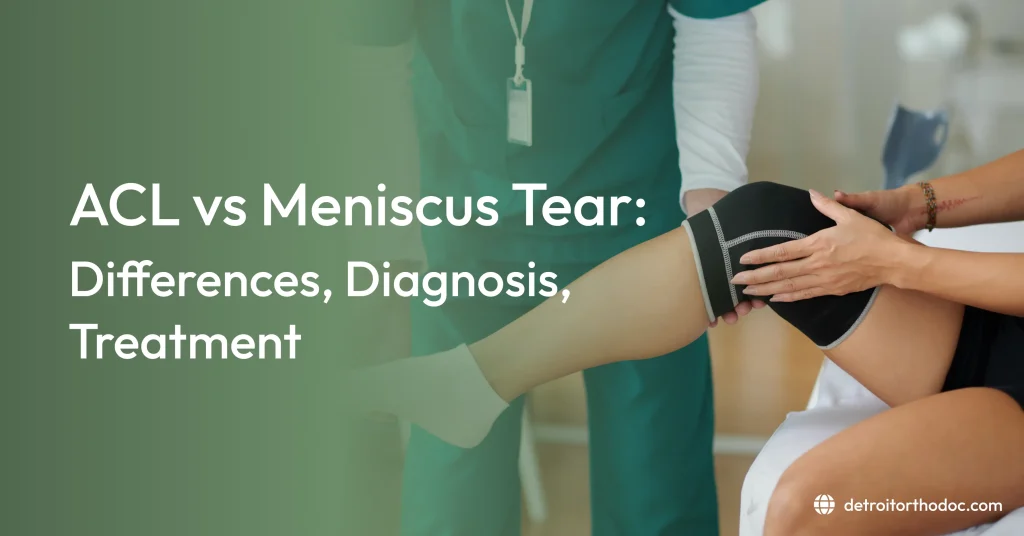
The anterior cruciate ligament (ACL) is one of the main ligaments that stabilizes the knee. The American Academy of Orthopaedic Surgeons (AAOS) notes that athletes in high-demand sports like soccer, football, and basketball are more likely to injure it.
ACL tears often happen during a sudden stop, pivot, or awkward landing. Many people feel or hear a pop, followed by swelling and a sense that the knee is unstable.
Depending on your activity level and the severity of the tear, treatment ranges from structured rehabilitation to arthroscopic ACL reconstruction.
3. Meniscus Tears
The meniscus is a C-shaped piece of cartilage that cushions the knee joint. It can tear when you twist the knee while your foot is planted.
Symptoms include pain along the joint line, swelling, stiffness, and a catching or locking sensation. Because ACL and meniscus injuries often happen together and feel similar, a proper exam matters. Our guide to ACL vs meniscus tears explains the differences, and you can read more about meniscus tear treatment.
4. Rotator Cuff and Labral Injuries
The rotator cuff is a group of muscles and tendons that keeps the shoulder stable and helps you lift and rotate your arm. The labrum is a ring of cartilage that deepens the shoulder socket.
Repetitive overhead motion in baseball, swimming, volleyball, and tennis can strain these structures over time. A fall or a sudden forceful movement can also tear them.
Warning signs include pain when reaching overhead, weakness, clicking, and pain that wakes you at night. Learn more about rotator cuff tears and shoulder labral tears.
5. Tennis Elbow and Golfer’s Elbow
Tennis elbow affects the tendons on the outside of the elbow. Golfer’s elbow affects the inside. Both are overuse injuries caused by repeated gripping and wrist movement, and pickleball has made them more common in recent years.
Pain usually builds gradually and can make gripping a racquet, a coffee cup, or a steering wheel uncomfortable. Many cases respond well to activity changes and targeted strengthening. Our article on at-home exercises for tennis elbow is a good starting point.
6. Achilles Tendon Injuries
The Achilles tendon connects the calf muscles to the heel bone. It can become irritated from overuse (tendinopathy) or rupture during an explosive push-off.
A rupture often feels like being kicked in the back of the ankle, and walking or rising onto your toes becomes difficult. A suspected rupture should be evaluated promptly, because early treatment affects recovery options. Learn more about our tendon and soft tissue injury care.
7. Hamstring and Groin Strains
A strain is a stretch or tear in a muscle or tendon. Hamstring strains are common in sprinting sports, while groin strains are frequent in hockey and soccer because of repeated side-to-side movement.
You may feel a sudden sharp pain in the back of the thigh or inner thigh, sometimes with bruising. Most strains heal with a gradual loading program. Severe strains, or those near where the tendon attaches to the bone, need specialist evaluation.
8. Hip Labral Tears
The hip labrum is cartilage that lines the rim of the hip socket. Tears are often linked to femoroacetabular impingement (FAI), a condition where the hip bones rub abnormally during movement.
Athletes may notice deep groin pain, clicking, or stiffness, especially when sitting, pivoting, or bringing the knee toward the chest. Read more about hip conditions we treat.
9. Shin Splints and Stress Fractures
Shin splints cause pain along the inner edge of the shinbone. They usually appear when runners increase mileage or intensity too quickly.
A stress fracture is a small crack in the bone caused by repeated stress. Pain that is sharp, focused on one spot, or present at rest can signal a stress fracture rather than shin splints and should be checked with imaging.
A note on concussions: Concussions are common in contact sports, but they are brain injuries, not orthopedic ones. If you suspect a concussion, stop playing and get evaluated by a physician the same day. The CDC’s HEADS UP program offers guidance for athletes, parents, and coaches.
Acute vs. Overuse Injuries: What Is the Difference?
NIAMS divides sports injuries into two groups:
- Acute injuries happen suddenly, from a fall, a blow, or a twisted joint. Sprains and dislocations are typical examples.
- Chronic (overuse) injuries develop gradually from repeated stress on one area. Tennis elbow and stress fractures are common examples.
The difference matters because overuse injuries usually point to a training pattern that needs to change. Without that change, the injury tends to come back.
What Should You Do Right After a Sports Injury?
For years, the standard advice was R.I.C.E. (rest, ice, compression, elevation). Newer guidance published in the British Journal of Sports Medicine expands on this with the PEACE & LOVE approach, which covers both the first days after an injury and the recovery that follows.
In the first few days (PEACE):
- Protect the injured area and limit painful movement for one to three days.
- Elevate the limb above heart level when you can.
- Avoid routine anti-inflammatory medication early on, as the authors note it may interfere with tissue healing. Check with your doctor before taking any medication.
- Compress the area with a bandage or brace to help control swelling.
- Educate yourself about the injury and avoid unnecessary passive treatments.
After the first few days (LOVE):
- Load the injured area gradually, letting pain guide how much you do.
- Stay optimistic. Expectations influence recovery.
- Add pain-free vascular (cardio) exercise to keep blood flowing.
- Exercise to restore strength, mobility, and balance.
Self-care is appropriate for mild injuries. The next section explains when you should not wait.
When Should You See an Orthopedic Specialist?
Book an evaluation if you notice any of the following:
- You cannot put weight on the injured leg, or you cannot use the arm normally
- The joint feels unstable or gives way
- You felt or heard a pop at the time of injury
- There is a visible deformity or a joint that looks out of place
- Swelling is significant or keeps returning
- Pain, weakness, or stiffness is not improving after several days of self-care
- Numbness or tingling in the injured limb
For more warning signs, see our guide on when to see a sports medicine specialist.
How Are Sports Injuries Diagnosed?
An accurate diagnosis starts with a detailed history of how the injury happened and a hands-on physical exam that tests strength, stability, and range of motion.
Our offices provide on-site X-ray and diagnostic ultrasound. X-rays show bone injuries such as fractures. Ultrasound gives a real-time view of tendons, ligaments, and muscles. When a deeper look at cartilage or ligaments is needed, an MRI may be ordered.
Sports Injury Treatment Options
Sports injury treatment is matched to the injury, your sport, and your goals. We start with conservative care and recommend surgery only when it is likely to give you a better outcome.
- Activity changes and protected return: a plan that keeps you moving without aggravating the injury.
- Bracing and supports: braces, crutches, and other durable medical equipment are available in-office, so you leave with the support you need.
- Sports injury rehabilitation: a structured physical therapy program to rebuild strength, flexibility, and movement control. NIAMS notes that rehabilitation is usually recommended before returning to the activity that caused the injury.
- Injection-based treatments: options such as PRP (platelet-rich plasma) therapy may be considered for certain tendon and ligament problems.
- Surgery: for complete ligament tears, significant cartilage or tendon damage, or injuries that do not respond to conservative care. Procedures include arthroscopic ACL reconstruction, meniscus repair, rotator cuff and labral repair, and Achilles tendon repair.
You can explore our full approach on the sports injury care and sports medicine pages.
How to Lower Your Risk of Sports Injuries
- Warm up with dynamic movement before training or games.
- Increase training volume and intensity gradually, especially when returning after a break.
- Build strength and balance in the off-season, not just during it.
- Use sport-appropriate footwear and replace worn-out running shoes.
- Treat nagging pain early instead of playing through it.
- Allow full recovery before returning to play after an injury.
Sports Injury Care for Metro Detroit Athletes
Dr. Matthew Yousif, DO is a board-certified, fellowship-trained orthopedic surgeon with over 15 years of combined medical and surgical experience. He completed his orthopedic surgery residency at Beaumont Health and a sports medicine fellowship at Strong Memorial Hospital.
Patients from across Metro Detroit see Dr. Yousif at our two offices: our Troy office on West Big Beaver Road and our Shelby Township office on Van Dyke Avenue. Whether you are a high school athlete, a weekend runner, or a lifelong competitor, the goal is the same: an accurate diagnosis, a clear plan, and a safe return to the sport you enjoy.
Ready to get back in the game? Book an appointment or call 248-329-0711.