Quick answer: Hip pain at night is most often caused by gluteal tendinopathy, a tendon problem on the outside of the hip that hurts when you lie on it. Arthritis, labral tears, and nerve or spine problems are other common causes. Sleeping on your back, or on the pain-free side with a full-length pillow between your knees and ankles, often helps. See a doctor if night pain lasts more than three to four weeks.
There is a particular frustration to a hip that behaves all day and then won’t let you sleep. You got through work and the stairs without thinking about it. Then you lie down, and an hour later you are turning over for the fourth time, wedging pillows, and counting the hours until the alarm.
Night pain is not simply daytime pain that got louder. It has its own causes and its own fixes, and the most common cause is more treatable than most people expect. Pain on the outside of the hip, the type most likely to wake you, affects an estimated 10 to 25 percent of people in industrialized countries and is three to four times more common in women (Williams and Cohen, 2009; Del Buono et al., 2012).
This guide covers why nights are worse, what different pain patterns mean, how to position yourself for sleep, and when night pain needs an evaluation. For the bigger picture, see our article on hip pain when walking.
Why Is Hip Pain Worse at Night?
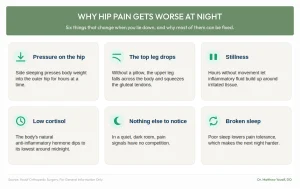
Several things change when you lie down, and usually more than one applies.
1. You press on the hip for hours
Side sleeping puts your upper body weight straight through the greater trochanter, the bony point on the outside of the hip. The tendons and bursa over that bone stay squeezed against the mattress. During the day you shift position constantly; asleep, you may hold one position for an hour or more.
2. The top leg drops across your body
This is the most overlooked factor. Without support between your knees, the upper leg falls forward and across your body. That position presses the gluteal tendons hard against the bone, and many side sleepers hold it all night.
3. Inflammation builds while you are still
Movement helps clear inflammatory byproducts from irritated tissue. Hours of stillness let them collect around the joint, tendons, and bursa.
4. Cortisol is at its daily low
Cortisol, the body’s natural anti-inflammatory hormone, follows a daily rhythm. It peaks in the early morning and is lowest around midnight, so your natural protection against inflammation is weakest when you are trying to sleep (Thau et al., StatPearls).
5. Nothing else competes for your attention, and poor sleep makes it worse
In a dark, quiet room, pain signals have no competition, so the same signal feels stronger. Broken sleep then lowers pain tolerance the next night. Improving sleep is part of treating the pain, not a separate problem.
What Causes Hip Pain at Night?
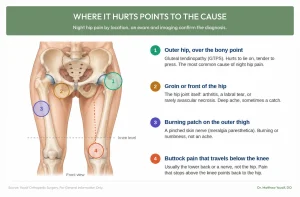
Where you feel the pain is one of the most useful clues to what is causing it.
| Cause | Where you feel it | Typical night pattern |
|---|---|---|
| Gluteal tendinopathy (GTPS) | Outer hip, over the bony point | Hurts to lie on either side; tender to press |
| Hip osteoarthritis | Groin or front of the hip | Deep ache, usually later in the disease; may ease with gentle walking |
| Labral tear | Deep groin, with clicking or catching | Pain in certain rotated positions or when rolling over |
| Avascular necrosis | Groin | Worse at rest and at night; can be severe |
| Inflammatory arthritis | Hip and lower back | Worst late at night, with morning stiffness over an hour |
| Spine or nerve | Buttock, often down the leg | Changes with back position; numbness or tingling |
1. Greater trochanteric pain syndrome (gluteal tendinopathy)
This is the most common cause of night hip pain and is often mistaken for arthritis. It usually means wear in the gluteus medius and minimus tendons where they attach to the outer hip, sometimes with an irritated bursa alongside. It is most common between the ages of 40 and 60 and affects women more often than men (Del Buono et al., 2012). For decades it was simply called bursitis, but tendon problems are the main issue in most cases. See our guide to hip bursitis [spoke link: URL TBD].
Typical signs include:
- Pain when lying on the sore side, often enough to wake you
- Pain when lying on the other side too, because the top leg drops across the body
- Tenderness when you press on the bony point of the outer hip
- Trouble finding any comfortable side position
If pressing on that bony point reproduces your night pain, gluteal tendinopathy is a likely suspect, and it is one of the more treatable causes. An exam confirms it and rules out other problems.
2. Hip osteoarthritis
Arthritic night pain is a deep ache in the groin or front of the hip rather than the outer side. Early arthritis usually hurts with activity and settles at rest, so night pain tends to appear later. Once night pain becomes regular, it is a sign the arthritis is progressing. Gentle movement often eases it, which is why people with arthritis sometimes find walking around the bedroom helps.
3. Labral tear
The labrum is the rim of cartilage around the hip socket. Labral tear hip pain at night is usually a deep groin pain with clicking or catching, often in specific positions such as the leg turned outward or when rolling over. Keeping the hip in a neutral position with pillows often helps.
4. Avascular necrosis
Avascular necrosis (osteonecrosis) of the femoral head causes groin pain that is often worse at rest and at night. Early diagnosis changes the treatment options, so it deserves attention in anyone with risk factors such as long-term steroid use, heavy alcohol use, sickle cell disease, prior hip injury, or immune-suppressing medication.
5. Inflammatory arthritis
Rheumatoid arthritis, ankylosing spondylitis, and psoriatic arthritis cause night and early-morning pain with stiffness lasting more than an hour. Ankylosing spondylitis often starts in younger adults with hip and lower back pain that is worst in the second half of the night and improves with moving. That is the reverse of mechanical pain.
6. Fractures
A stress fracture of the femoral neck can hurt at rest and at night. In older adults with weak bones, an insufficiency fracture can happen after a minor fall, or none you remember, and show up mainly as night pain. New, persistent night hip pain in anyone over 60, especially after a fall, should be imaged.
7. Pain from the spine
Disc problems, facet arthritis, and spinal stenosis can all send pain into the hip and buttock, and lying flat can aggravate some of them. Many people who describe “hip pain” at night actually have a spine problem.
Serious causes that need to be ruled out
Constant night pain that doesn’t change with position, especially with fever, unexplained weight loss, night sweats, or a cancer history, needs prompt evaluation. Bone infection and cancer can present this way. These causes are uncommon, but they are why doctors take night pain seriously.
Hip and Leg Pain at Night
When hip and leg pain at night happen together, the cause is more often a nerve or the spine than the hip joint itself.
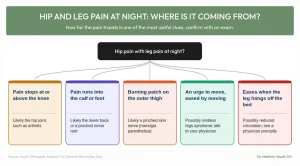
Pain that stops at or above the knee usually comes from the hip. Pain that continues into the calf and foot usually comes from the lower back. Spinal stenosis tends to be worse with standing and walking and eased by sitting or bending forward. Deep gluteal syndrome causes deep buttock pain that is worse with sitting or lying on that side.
Two conditions are often confused with hip problems. Restless legs syndrome causes an urge to move rather than true pain and is often linked to low iron, so it is worth raising with your physician. Reduced circulation (peripheral arterial disease) can cause leg pain at rest that eases when the leg hangs over the edge of the bed, and it needs prompt medical review.
Burning Hip Pain at Night
Burning hip pain at night, a hot, searing, or electric feeling rather than an ache, points toward a nerve rather than the joint or tendons.
- Meralgia paresthetica: a skin nerve near the front of the pelvis gets compressed, causing burning, numbness, or tingling on the outer thigh. Tight waistbands, belts, tool belts, extra weight, and pregnancy are common triggers. People can often outline the exact patch with a finger.
- Lumbar radiculopathy: burning that follows a nerve path down the leg.
- Peripheral neuropathy: including diabetic neuropathy, which is usually worse at night and often starts in the feet.
Nerve pain often responds poorly to standard anti-inflammatory medicine, which is itself a clue. It is treated with different medications that need a prescription and monitoring.
Night Hip Pain in Women
The orthopedic causes are the same for everyone, and the side doesn’t carry special meaning. Pain in the left hip area at night in women has the same likely causes as pain on the right. A few points are still worth knowing:
- Gluteal tendinopathy is far more common in women, especially around and after menopause. Changing hormone levels affect tendon health, and a wider pelvis changes how the gluteal tendons are loaded.
- Osteoporosis is more common in women, which raises the risk of a fracture showing up as unexplained night pain.
- Gynecologic conditions such as endometriosis, ovarian cysts, and pelvic congestion can refer pain to the hip. Consider them when pain follows your menstrual cycle, comes with pelvic symptoms, or doesn’t change with hip position.
- Hip dysplasia, a shallow socket, is more common in women and can go unnoticed into adulthood.
A practical test: if changing your hip position changes the pain, it is likely a muscle, tendon, or joint problem. If position makes no difference at all, look further.
Best Sleep Positions for Hip Pain
This is where most people see the fastest improvement, and it costs nothing beyond a pillow or two.
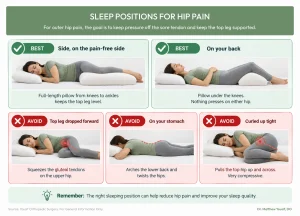
If the pain is on the outer hip
- Sleep on the pain-free side with a firm, full-length pillow between your knees and ankles. Supporting only the knee lets the lower leg drop, which is why small pillows often don’t work.
- Try sleeping on your back with a pillow under your knees. Nothing presses on either hip.
- Check your mattress. A very firm mattress concentrates pressure on the hip; a 2 to 3 inch foam topper spreads it out. A mattress so soft that your pelvis sinks and tilts causes its own problems. Medium firmness with a cushioned surface usually works best.
- Avoid curling up tight with the top knee pulled up and across your body.
If the pain is in the groin or joint
- Sleep on your back with a pillow under the knees, which keeps the hip slightly bent and relaxed.
- If you sleep on your side, use a pillow between the knees to keep the painful hip in a neutral position.
- A rolled towel along the outer thigh stops the leg rolling outward, which helps labral tears that catch in that position.
- During a flare, a semi-reclined position can help some people with arthritis.
If the pain travels down your leg
- Lie on your side with knees bent and a pillow between them, or on your back with your knees well supported. Both open the spinal canal slightly.
- Avoid sleeping on your stomach, which arches the lower back and often aggravates nerve pain.
Stomach sleeping is generally the hardest position on painful hips. If you have slept that way for years, hugging a body pillow makes the switch easier. When getting out of bed, roll onto your side and push up with your arms rather than twisting.
How to Relieve Hip Pain at Night
- Time your medication. If an anti-inflammatory is appropriate for you, taking it about an hour before bed means it is working when you lie down. Check with your physician or pharmacist first, especially if you have kidney, stomach, heart, or bleeding concerns.
- Use heat or ice. Heat suits stiffness, such as arthritis. Ice suits a tender, irritated area. Use either for about 20 minutes.
- Move gently before bed. A few minutes of easy movement, such as knee-to-chest and gentle hip rotations, reduces stiffness. Save strengthening for the daytime.
- Try isometric holds for tendon pain. Gently pressing your knees outward against a strap or your hands for 30 to 45 seconds eases tendon pain for some people. Most evidence for this comes from other tendons, so treat it as worth trying rather than guaranteed.
- Limit evening alcohol. It makes sleep lighter in the second half of the night, when pain tends to surface.
- Get up if you can’t sleep. After about 20 minutes awake, sit somewhere dim and calm until you feel sleepy.
- Change daytime habits. Avoid crossing your legs, standing with your weight on one hip, and sitting in low chairs. What you do during the day affects how irritated the tissue is at night.
How Is Night Hip Pain Diagnosed?
An accurate diagnosis matters here because treatments differ so much between causes. Your surgeon will ask where the pain is, which positions trigger it, how it started, and whether it is getting worse. The exam includes watching you walk, testing hip motion and strength, pressing over the outer hip, and specific provocation tests. Standing on one leg for 30 seconds is often revealing for gluteal tendinopathy.
- X-rays show joint space and bone shape.
- MRI is best for tendon problems, labral tears, stress fractures, and avascular necrosis, which can be invisible on early X-rays.
- Ultrasound shows the tendons in motion and can guide injections. It is available in our office.
- A diagnostic numbing injection can show whether pain is coming from inside the joint.
Treatment for Hip Pain at Night
The right treatment depends on the cause.
1. Gluteal tendinopathy
Research favors a progressive exercise program over rest or repeated injections. In a randomized trial published in the BMJ, education plus exercise produced better overall improvement than a cortisone injection or a wait-and-see approach (Mellor et al., 2018). A 2024 systematic review reached the same conclusion, with low to moderate certainty (Physiotherapy, 2024).
Load management and better sleeping positions are the foundation. A cortisone injection can give short-term relief and help break the pain cycle, though repeated injections may weaken tendon tissue. In a trial of 80 patients with chronic gluteal tendinopathy, a single PRP injection gave greater improvement at 12 weeks than a cortisone injection, with no difference at 2 or 6 weeks (Fitzpatrick et al., 2018). PRP is not FDA-approved for this use and is usually not covered by insurance.
2. Hip osteoarthritis
Exercise therapy, weight management, and appropriate medication are the core. Cortisone injections can help during flares. Gel injections (hyaluronic acid) are FDA-approved for knee arthritis only; using them in the hip is off-label and the evidence is limited. You may also see stem cell injections advertised for hip arthritis. Current guidelines advise against them for hip osteoarthritis, and our page on stem cell therapy for joint pain explains the evidence.
Regular night pain from advanced arthritis is one of the stronger reasons to consider joint replacement, because it means the arthritis is no longer responding to simpler measures. Learn more about hip surgery.
3. Labral tears
Physical therapy focused on hip stability comes first. Hip arthroscopy is considered for the right patients when therapy hasn’t helped.
4. Nerve-related and inflammatory causes
Nerve pain is treated at its source, whether that is the lower back or a trapped nerve, often with medications made for nerve pain. Inflammatory arthritis needs disease-modifying treatment with a rheumatologist, which is what actually settles the night symptoms.
Recovery Timeline for Gluteal Tendinopathy
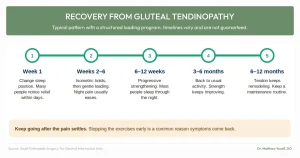
Timelines vary by diagnosis and can’t be guaranteed. Here is the typical pattern for gluteal tendinopathy, the most common cause of night hip pain.
| Timeframe | What usually happens |
|---|---|
| Week 1 | Sleep position changes; many people notice relief within days |
| Weeks 2 to 6 | Isometric holds, then gentle loading; night pain usually eases |
| 6 to 12 weeks | Progressive strengthening; most people sleep through the night |
| 3 to 6 months | Return to usual activity; strength keeps improving |
| 6 to 12 months | Tendon keeps remodeling; a maintenance routine prevents relapse |
Tendons take longer to recover than most people expect. Stopping the program once the night pain settles is a common reason it comes back.
Risks of Ignoring Night Pain
Ongoing sleep loss lowers pain tolerance and affects mood, concentration, and overall health, and fatigue leads to less activity and weaker muscles. Treatments carry their own risks, including the stomach, kidney, and heart effects of anti-inflammatory medicine and possible tendon weakening with repeated cortisone. The biggest risk with some causes is a delayed diagnosis: avascular necrosis and stress fractures do much better when caught early.
Contact your physician promptly if you can’t bear weight, have a fever with hip pain, notice sudden severe worsening, or develop new numbness or weakness in the leg.
Common Mistakes
- Using a small pillow at the knee only. The lower leg still drops and the tendon stays squeezed.
- Assuming it’s arthritis. Outer hip night pain is more often a tendon problem, which needs different treatment.
- Stretching the sore area before bed. Cross-body and figure-four stretches compress an irritated gluteal tendon.
- Accepting months of broken sleep. Night pain is a specific signal, not a normal part of aging.
- Stopping the exercises once you sleep better. Pain relief comes months before the tendon fully recovers.
Prevention Checklist
- Strengthen your hip and glute muscles at least twice a week
- Use a full-length pillow between your knees and ankles if you sleep on your side
- Avoid standing with your weight on one hip or sitting with crossed legs
- Replace a sagging mattress, or add a topper
- Break up long periods of sitting, especially on long drives
- Build up walking or running gradually
- Deal with minor outer hip soreness before it becomes a night problem
Night Hip Pain and Life in Metro Detroit
A few everyday factors in Southeast Michigan can feed night hip pain. Long commutes in deep car seats hold the hip in a position that loads the outer hip. Winter moves activity indoors and can weaken the glutes, and a sudden return to outdoor activity in spring can irritate the tendons. Icy sidewalks raise the risk of falls, and in people with weaker bones a minor fall can cause a small fracture that shows up mainly as night pain. Jobs that involve long shifts standing on concrete load the hip muscles heavily.
Dr. Matthew Yousif, DO is a board-certified, fellowship-trained orthopedic surgeon with over 15 years of combined medical and surgical experience. He sees patients from Oakland and Macomb counties at our Troy and Shelby Township offices, where on-site X-ray and diagnostic ultrasound allow bone and soft tissue to be assessed at the same visit.
When to See a Doctor for Hip Pain at Night
Night pain deserves a lower threshold for evaluation than daytime pain.
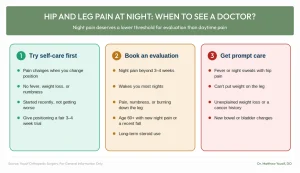
Book an evaluation if:
- Night pain has lasted more than three to four weeks despite position changes
- It wakes you most nights or affects how you function during the day
- It is steadily getting worse
- You have pain, numbness, tingling, burning, or weakness down the leg
- You take long-term steroids or have other risk factors for avascular necrosis
- You are over 60 with new night pain, especially after a fall
- Morning stiffness lasts more than an hour, or several joints are involved
Get prompt care for: night pain with fever, unexplained weight loss, or night sweats; inability to bear weight; new unrelenting night pain with a cancer history; or new bowel or bladder changes with leg symptoms.
Conclusion
Hip pain at night usually has a mechanical cause and a practical fix. Outer hip pain that hurts when you lie on it is most often gluteal tendinopathy, and it often improves a lot just from sleeping on the other side with a full-length pillow between your knees and ankles.
Deep groin pain points to the joint. Pain down the leg points to the spine. Burning points to a nerve. Each needs a different treatment, which is why an accurate diagnosis matters. Give positioning and self-care a fair trial of a few weeks, but don’t accept months of broken sleep as normal.
This article is for general education and is not medical advice. It does not create a physician-patient relationship. Talk with a qualified healthcare provider about your symptoms.
References
- Williams BS, Cohen SP. Greater trochanteric pain syndrome: a review of anatomy, diagnosis and treatment. Anesthesia & Analgesia. 2009;108(5):1662-1670.
- Del Buono A, Papalia R, Khanduja V, et al. Management of the greater trochanteric pain syndrome: a systematic review. British Medical Bulletin. 2012;102:115-131.
- Speers CJ, Bhogal GS. Greater trochanteric pain syndrome: a review of diagnosis and management in general practice. British Journal of General Practice. 2017;67(663):479-480. bjgp.org
- Mellor R, Bennell K, Grimaldi A, et al. Education plus exercise versus corticosteroid injection use versus a wait and see approach on global outcome and pain from gluteal tendinopathy. BMJ. 2018. PubMed
- Exercise compared to a control condition or other conservative treatment options in patients with greater trochanteric pain syndrome: a systematic review and meta-analysis. Physiotherapy. 2024. ScienceDirect
- Fitzpatrick J, Bulsara MK, O’Donnell J, McCrory PR, Zheng MH. The effectiveness of platelet-rich plasma injections in gluteal tendinopathy: a randomized, double-blind controlled trial. American Journal of Sports Medicine. 2018;46(4):933-939. DOI
- Thau L, Gandhi J, Sharma S. Physiology, Cortisol. StatPearls. NCBI Bookshelf. NCBI