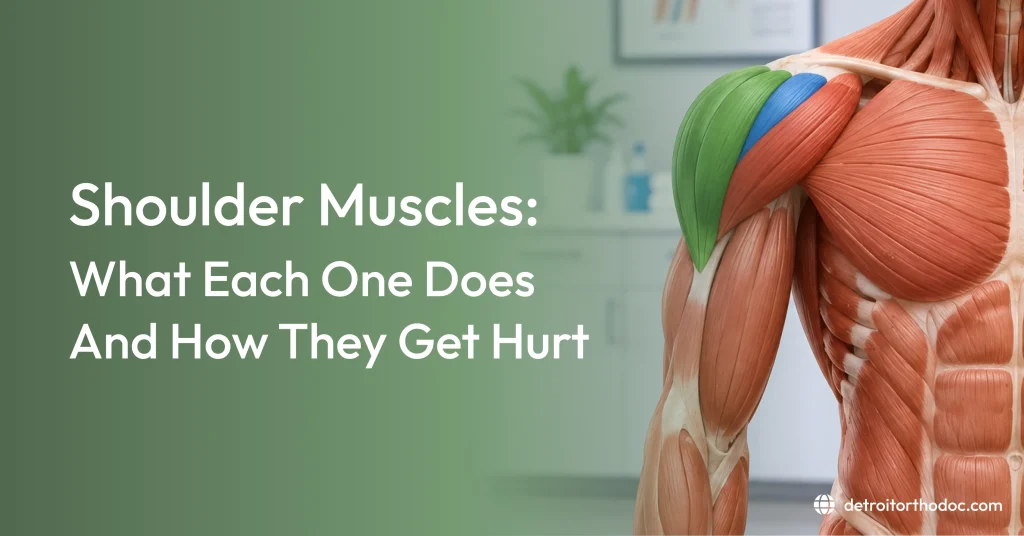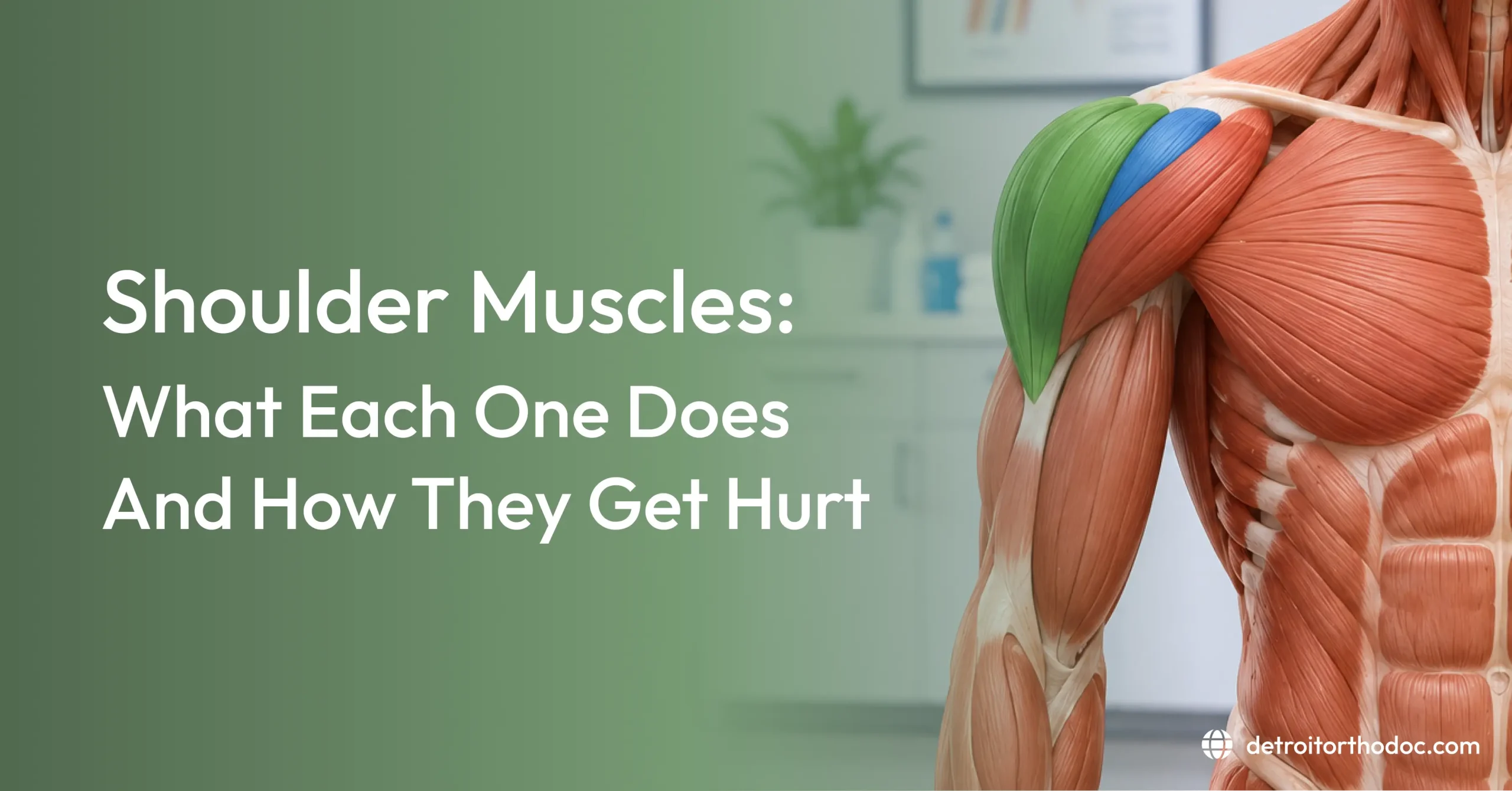
The short answer: the shoulder has more than a dozen muscles, and the deltoid is only one of them. Four small rotator cuff muscles keep the ball of your arm bone centered in its shallow socket, while larger muscles across the chest, back and shoulder blade supply power and steer the socket as your arm moves.
A common question we hear is which muscle does the lifting. The deltoid gets the credit, but it can’t do the job without the rest of the group, which is also why a problem in one small muscle can change how the whole shoulder feels. This guide covers the muscles themselves. For the bones, joints and ligaments, see our shoulder anatomy guide.
Below you’ll find a muscle-by-muscle table, what the shoulder press actually works, how these muscles get injured and when pain needs a doctor.
Which muscles are in the shoulder?
The muscles of the shoulder fall into four groups, the front muscles, the back muscles, the shoulder blade stabilizers and the rotator cuff, with the deltoid capping the whole joint. This is the shoulder muscles anatomy at a glance, with each shoulder muscle name, its group and its main job.
| Muscle | Group | Main job |
| Deltoid (front, side and rear parts) | Outer cap | Lifts the arm in nearly every direction |
| Pectoralis major | Front | Pulls the arm forward and across the body |
| Pectoralis minor | Front, deep | Tilts and steadies the shoulder blade |
| Coracobrachialis | Front, deep | Helps lift the arm forward |
| Supraspinatus | Rotator cuff | Helps the deltoid lift the arm out to the side |
| Infraspinatus | Rotator cuff | Turns the arm outward |
| Teres minor | Rotator cuff | Turns the arm outward |
| Subscapularis | Rotator cuff | Turns the arm inward |
| Latissimus dorsi | Back | Pulls the arm down and back |
| Teres major | Back | Helps pull the arm back and turn it inward |
| Trapezius (upper, middle, lower) | Shoulder blade | Rotates, lifts and steadies the shoulder blade |
| Rhomboids (major and minor) | Shoulder blade | Pull the shoulder blades together |
| Serratus anterior | Shoulder blade | Holds the blade flat against the ribs |
| Levator scapulae | Shoulder blade | Lifts the shoulder blade |
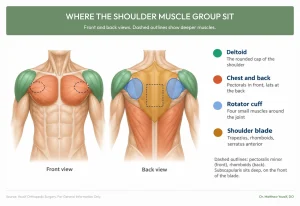
Many of these muscles do more than one job and the groups overlap, so read the table as a map, not a rulebook. The picture below shows where the groups sit from the front and the back.
When does shoulder muscle pain need a doctor?
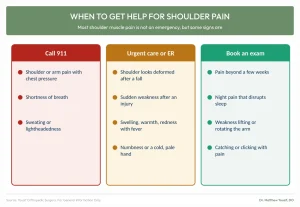
Book an exam if shoulder pain lasts more than a few weeks, wakes you at night or comes with weakness, and get urgent help for the signs below. Not every ache needs a scan or a specialist, because mild strains often settle with a short break from whatever set them off.
Call 911 for shoulder or arm pain with chest pressure, shortness of breath, sweating or lightheadedness. Pain from the heart can show up in the shoulder.
Go to urgent care or the emergency room for:
- A shoulder that looks out of place or deformed after a fall
- Sudden weakness, or being unable to lift the arm after an injury
- Swelling, warmth and redness, especially with a fever
- Numbness, tingling, or a cold, pale hand
Book an appointment if you have:
- Pain that has lasted beyond a few weeks
- Night pain that disrupts sleep
- Weakness or trouble lifting or rotating the arm
- Catching or clicking that comes with pain
What do the front shoulder muscles do?
The front (anterior) shoulder muscles push, reach and lift. They are the muscles most people train hardest, and the ones most likely to tighten from desk work.
- Anterior deltoid lifts the arm forward and does much of the work in an overhead press.
- Pectoralis major is the large chest muscle that pulls the arm forward and across the body.
- Pectoralis minor sits beneath it and tilts the shoulder blade forward.
- Coracobrachialis is a small deep muscle that helps lift the arm forward.
Tight chest muscles can pull the shoulders forward and rounded. The biceps tendon also runs through the front of the shoulder, which is why biceps tendon irritation is often felt as shoulder pain.
What are the back shoulder muscles?
The back (posterior) shoulder muscles pull the arm back, turn it outward and hold your posture. They include the posterior deltoid, latissimus dorsi, teres major, infraspinatus, teres minor, the rhomboids, and the middle and lower trapezius.
Honestly, the back of the shoulder is the group people most often under-train, especially if they sit at a desk or press more than they pull. The latissimus dorsi is the big muscle that pulls the arm down and back, the rhomboids and middle trapezius draw the shoulder blades together, and the posterior deltoid and the two small cuff muscles at the back turn the arm outward. Strong back shoulder muscles balance the pushing muscles at the front.
What do the shoulder blade muscles do?
The shoulder blade muscles, also called scapular stabilizers, tether the blade to your spine and ribs and steer it as your arm moves. The trapezius, serratus anterior, rhomboids and levator scapulae do most of that work, and together with the muscles that move the collarbone they are sometimes called the shoulder girdle muscles.
The blade has to rotate and glide in rhythm with the arm. When it doesn’t, a pattern called scapular dyskinesis, the space for the rotator cuff tendons may narrow, and reaching overhead can start to hurt. Serratus anterior and lower trapezius weakness are common findings in that pattern [VERIFY]. Our shoulder blade pain guide covers what blade pain can mean.
Worth knowing: the neck and shoulder muscles overlap. The upper trapezius and levator scapulae run from the neck down to the shoulder blade, so tension in the neck is often felt in the shoulder, and the reverse.
What are the four rotator cuff muscles?
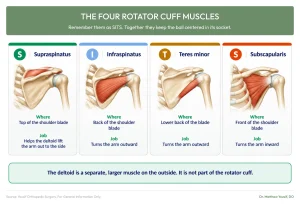
The rotator cuff is four muscles, the supraspinatus, infraspinatus, teres minor and subscapularis (SITS), whose tendons form a cuff around the top of the arm bone. They are small next to the deltoid, but they keep the ball centered in the socket while the bigger muscles move the arm.
- Supraspinatus sits on top of the shoulder blade and helps the deltoid lift the arm out to the side.
- Infraspinatus and teres minor sit at the back of the blade and turn the arm outward.
- Subscapularis sits on the front surface of the blade and turns the arm inward.
The deltoid is not part of the rotator cuff. It is a separate, larger muscle on the outside of the joint.
Rotator cuff tears become more common with age, and many cause no pain at all. In one community screening study, about two-thirds of the tears found were painless. A tear on an MRI doesn’t automatically explain your pain, and many partial tears improve with therapy. Our rotator cuff tear page explains how tears are diagnosed and treated.
How do the shoulder muscles work together?
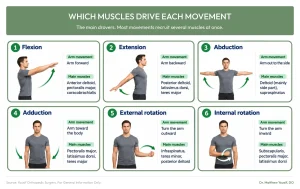
Every shoulder movement uses several muscles at once, with some producing the motion and others steadying the joint. The table lists the main drivers of each movement, including the shoulder flexion, abduction, adduction and external rotation muscles people often search for.
| Movement | In plain terms | Main muscles |
| Flexion | Raising the arm forward | Anterior deltoid, pectoralis major, coracobrachialis |
| Extension | Moving the arm backward | Posterior deltoid, latissimus dorsi, teres major |
| Abduction | Lifting the arm out to the side | Deltoid (mainly the side part), supraspinatus |
| Adduction | Bringing the arm toward the body | Pectoralis major, latissimus dorsi, teres major |
| External rotation | Turning the arm outward | Infraspinatus, teres minor, posterior deltoid |
| Internal rotation | Turning the arm inward | Subscapularis, pectoralis major, latissimus dorsi, teres major |
During all of these, the rotator cuff keeps the ball centered while the shoulder blade muscles position the socket. When either partner is weak or sore, the other tends to compensate.
What muscles does the shoulder press work?
The shoulder press works mainly the front and side parts of the deltoid and the triceps, with the upper trapezius, serratus anterior and upper chest helping, and the rotator cuff and core steadying the lift. That is why it trains far more than the shoulder cap alone.
Electromyography (EMG) studies, which measure electrical activity in muscle, generally show the deltoid and upper trapezius working hardest in overhead pressing, with serratus anterior helping the blade rotate upward so the arm can travel overhead. Dumbbell and machine presses train the same main muscles as a barbell, though dumbbells tend to ask more of the stabilizers because each arm works on its own.
Which muscles do other shoulder exercises work?
| Exercise | Main muscles worked |
| Lateral raise | Side deltoid, supraspinatus |
| Shoulder shrug | Upper trapezius, levator scapulae |
| Face pull | Posterior deltoid, rhomboids, middle trapezius, infraspinatus, teres minor |
| Band external rotation | Infraspinatus, teres minor |
| Seated row | Latissimus dorsi, rhomboids, middle trapezius, posterior deltoid |
How do shoulder muscles get injured?
Most shoulder muscle injuries are strains or tendon problems that come from overuse, a sudden heavy load or gradual wear with age. The usual types are:
- Strain: muscle fibers overstretched or partly torn.
- Tendinopathy: a long-running overuse irritation of a tendon, often in the rotator cuff.
- Partial-thickness tear: a tear through part of the tendon.
- Full-thickness tear: the tendon separates completely, often after a fall or heavy lift or as wear builds over time.
A common presentation: a weekend painter in their 50s with an ache over the outer shoulder when reaching up, and pain that wakes them when they roll onto that side. That pattern points toward the rotator cuff, and it is a good reason to get an exam instead of waiting it out.
Not every shoulder pain starts in a muscle. Tendons pinched during overhead motion cause shoulder impingement, the joint capsule stiffens in frozen shoulder, arthritis wears the joint surface, and neck problems can refer pain to the shoulder. Overhead athletes, manual workers and older adults carry a higher risk of muscle and tendon injury. Our sports injury care page covers athletes in more detail.
How are shoulder muscle problems diagnosed and treated?
Diagnosis starts with a history and a hands-on exam, imaging confirms what the exam suggests, and most muscle and tendon problems improve without surgery. Dr. Matthew Yousif, DO, is a fellowship-trained orthopedic surgeon who sees shoulder patients at the Troy office.
The exam checks your range of motion, strength and specific tests for the rotator cuff and shoulder blade movement. An X-ray shows bone and arthritis and is available in-house. Ultrasound shows tendons, including how they move, and an MRI gives the most detail on muscle, tendon and labrum.
Most shoulder muscle injuries start with non-surgical care:
- Changing or pausing the overhead activity that aggravates the shoulder
- Physical therapy focused on the rotator cuff and shoulder blade muscles
- Short-term anti-inflammatory medicine for pain
- A corticosteroid injection in selected cases of persistent inflammation
Surgery is generally reserved for full-thickness tears in suitable patients, or for shoulders that haven’t improved with a proper trial of therapy. Research on PRP injections for rotator cuff tendon problems is mixed, so it is a conversation to have, not a default. If surgery is on the table, our shoulder surgery page explains the options.
How do you build shoulder muscles safely?
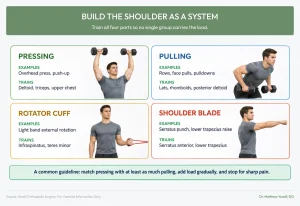
Build the shoulder as a system: train pushing, pulling, rotator cuff and shoulder blade work together, and add load gradually. A shoulder muscles workout that only presses leaves the stabilizers behind, and that is a common route to pain.
- Pressing such as the overhead press, with good control of the shoulder blade.
- Pulling such as rows and face pulls, which build the back of the shoulder.
- Rotator cuff work such as light, slow band external rotations.
- Shoulder blade drills such as serratus punches and lower trapezius raises.
A common guideline is to match pressing with at least as much pulling. The small cuff muscles respond to consistent, light work more than to heavy loads, and many therapy programs train them a few times a week. Warm up before heavy or overhead lifting, and rest between hard shoulder sessions. Behind-the-neck pressing puts the shoulder in a position many people tolerate poorly, so it is worth skipping if it pinches.
Which mistakes set up a shoulder injury?
- Training push far more than pull, which can pull the shoulders forward and stress the joint.
- Skipping the rotator cuff, because small stabilizers protect the joint that large muscles move.
- Adding weight too fast. The shoulder tolerates gradual progress better than big jumps.
- Working through sharp pain. Sharp or worsening pain is a signal to stop.
- Ignoring the shoulder blade, since poor blade control can crowd the cuff tendons.
- Skipping rehab after an injury, which leaves strength gaps that can lead to a repeat.
Shoulder muscle myths
- Myth: the deltoid does all the work. In fact, the rotator cuff and shoulder blade muscles are just as important.
- Myth: a rotator cuff tear always needs surgery. Many are managed without it.
- Myth: a tear on imaging always explains the pain. Many tears are painless, especially with age.
- Myth: shoulder pain means complete rest. Guided movement usually helps more than rest alone.
References
- Rotator Cuff Injury. NIH StatPearls. https://www.ncbi.nlm.nih.gov/books/NBK547664/
- Minagawa H, et al. Prevalence of symptomatic and asymptomatic rotator cuff tears in the general population. J Orthop, 2013. PubMed [VERIFY authors and figure]. https://pubmed.ncbi.nlm.nih.gov/24403741/
- Tempelhof S, Rupp S, Seil R. Age-related prevalence of rotator cuff tears in asymptomatic shoulders. J Shoulder Elbow Surg, 1999. PubMed. https://pubmed.ncbi.nlm.nih.gov/10471998/
- Shoulder Muscle Activation of Novice and Resistance Trained Women during Variations of Dumbbell Press Exercises. National Institutes of Health (PMC). https://www.ncbi.nlm.nih.gov/pmc/articles/PMC4590897/
- The Effect of the Weight and Type of Equipment on Shoulder and Back Muscle Activity in Surface Electromyography during the Overhead Press. National Institutes of Health (PMC) [VERIFY]. https://www.ncbi.nlm.nih.gov/pmc/articles/PMC9781216/